
Key Takeaways
- Falling software-build costs from AI don't automatically erode software value, enterprise switching costs, trust, and distribution still protect incumbents.
- AI productivity tools change how software is built and used, but not the enterprise realities, integration, compliance, and inertia, that create durable moats.
- The SaaS moat is shifting, not disappearing: incumbents with data, distribution, and embedded workflows are positioned to adapt.
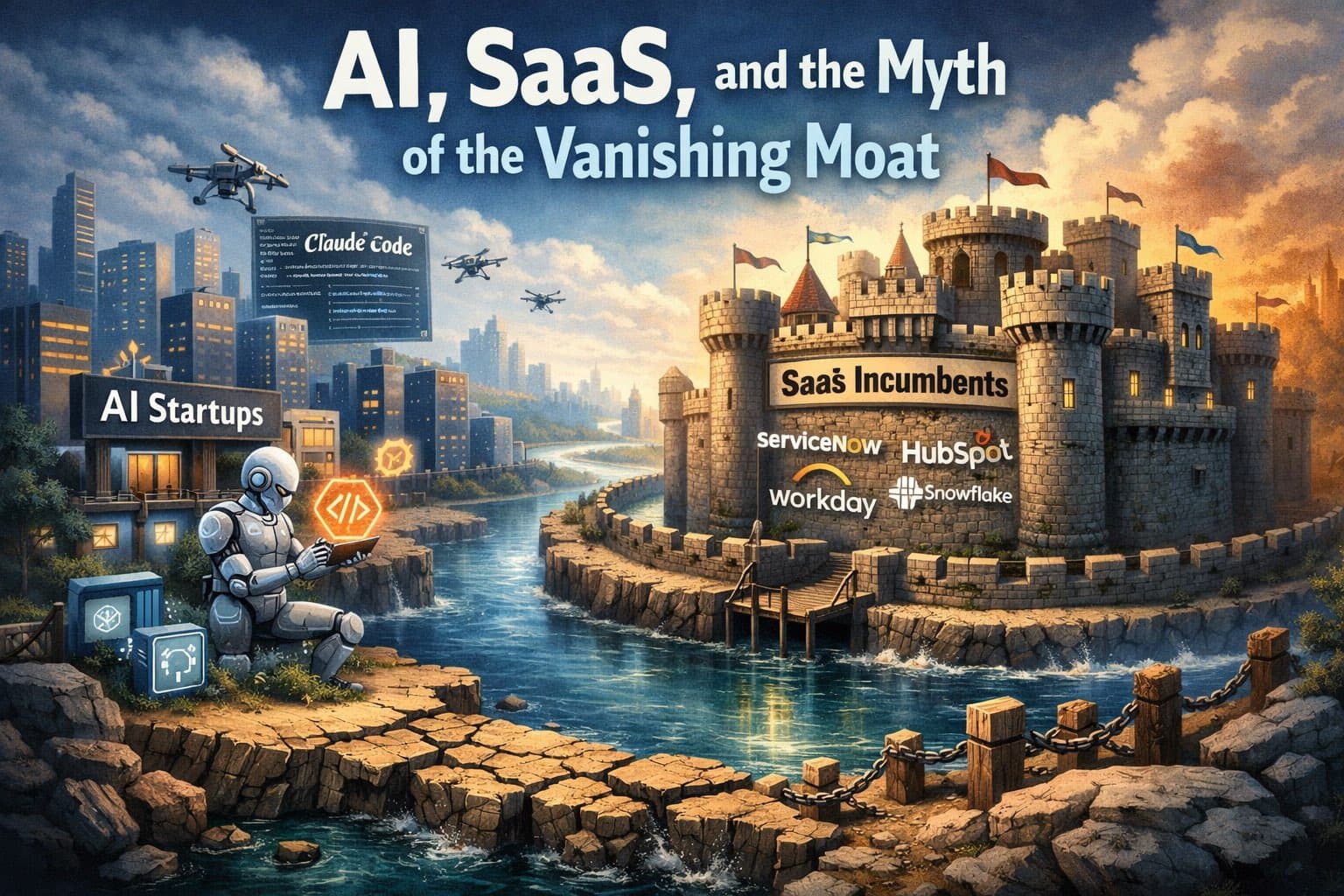
Since Q4 of last year and through the first month of 2026, software stocks have taken a noticeable hit. Many well known SaaS companies have seen meaningful multiple compression, even when revenue growth has remained solid. The market's explanation is simple on the surface. Investors are worried that the traditional SaaS moat is breaking down under pressure from AI native startups and AI coding platforms like Claude Code.
The narrative goes something like this. If anyone can spin up software with natural language, why do enterprises need expensive, slow moving incumbents? If workflows can be rebuilt faster and cheaper by AI first companies, why pay for bloated platforms designed in a pre AI world?
It is a compelling story. But it is also incomplete.
While AI is absolutely changing how software is built and used, the conclusion that every incumbent SaaS player faces an existential threat may be premature. History, economics, and enterprise reality all suggest a more nuanced outcome.
Why Falling Software Costs Do Not Mean Falling Software Value
One important idea often missed in the current debate is a basic economic principle. When the cost of producing something declines, usage tends to increase. This is not new, and it is not unique to software.
We have seen this pattern play out repeatedly. As computing power became cheaper, more software was written. As storage costs collapsed, companies stored more data. As bandwidth improved, video streaming exploded.
Software is no different. AI driven development tools reduce the cost and time required to build applications. That does not shrink the software market. It expands it.
Lower development costs mean more use cases become economically viable. Internal tools that were never worth building before now make sense. Niche workflows can justify custom software. Departments that relied on spreadsheets can finally adopt real systems.
At the same time, lower cost does not mean lower expectations. In fact, it usually means the opposite. As software becomes more ubiquitous, users expect it to be faster, more reliable, better integrated, and more secure. The tolerance for clunky UX, downtime, or manual workarounds drops sharply.
This matters because delivering high quality enterprise software at scale is not just about writing code. It is about operating reliably in messy, regulated, security conscious environments.
Productivity Tools Change Workflows, Not Enterprise Reality
There is no question that AI powered development tools are impressive. No code and low code platforms dramatically improve developer productivity. AI assistants can scaffold applications, generate tests, and automate repetitive work.
Startups are also reimagining workflows from the ground up. Many AI native products are not simply replacing old screens with chat interfaces. They are collapsing steps, automating decisions, and rethinking how work flows across teams.
These are real innovations. They will create new winners.
But productivity gains do not automatically translate into enterprise adoption at scale. A proof of concept is not a production system. A working demo is not a compliant, auditable, secure platform trusted with core business processes.
This is where incumbents still have meaningful advantages. At the end of the day, incumbents have proven their ability to navigate within the silos of an enterprise, endure their sales cycle which can be long and demanding.
Distribution, Trust, and Inertia Are Not Accidents
Large SaaS companies did not achieve their position in the value chain by accident. Over years or decades, they built distribution channels, sales relationships, partner ecosystems, and customer trust. These assets are slow to build and difficult to replicate.
An enterprise buyer does not evaluate software the same way a startup founder does. The buying process involves procurement, security reviews, data audits, legal teams, compliance checks, and executive sign off. The risk of failure is asymmetric. If a new tool saves money but breaks a critical workflow, the downside is large. Therefore switching costs are real.
This naturally favors vendors with a track record. Familiarity with the decision makers and sponsors matter. Reference customers matter. Existing contracts matter.
Switching costs also matter more than many investors assume. Software rarely lives in isolation. It is integrated into ERP/payroll systems, finance tools, data warehouses, identity providers, and internal processes. Replacing one system often means touching many others.
Even if an AI startup offers a superior product on paper, the real question for an enterprise is whether the improvement is large enough to justify disruption.
Often, it is not.
The Two Frictions That Protect Incumbents
When thinking about competitive moats in SaaS, it helps to frame them in terms of friction. Not abstract brand value or vague stickiness, but very real operational friction.
There are two types that matter most.
Friction to Switch In
This is the friction an AI upstart faces when trying to enter an enterprise environment.
Before a new vendor is approved, it must clear a long list of hurdles. Security reviews. SOC 2 compliance. Data residency requirements. Penetration testing. Vendor risk assessments. Legal negotiations. Successful proof of concept deployments.
None of this is optional. None of it is fast.
For a small AI startup, meeting these requirements is expensive and time consuming. It diverts focus from product development and customer acquisition. It also slows down sales cycles dramatically.
Incumbent SaaS vendors have already paid this cost. In many cases, they have dedicated teams whose sole job is to manage compliance, security, and enterprise risk. That infrastructure is not glamorous, but it is valuable.
Friction to Switch Out
The second type of friction is faced by the customer, not the vendor.
Replacing an incumbent SaaS platform involves data migration, process redesign, employee retraining, and often cultural change. Reports need to be rebuilt. Integrations need to be rewritten. Support teams need to be retrained.
Even when the new product is better, the transition is risky. During the migration period, productivity often drops. Mistakes happen. Edge cases emerge.
This creates a strong bias toward incremental improvement rather than wholesale replacement. Enterprises are far more willing to adopt new capabilities within an existing platform than to rip and replace the platform itself.
This is why many AI upstarts are initially adopted at the edges. As copilots. As add ons. As experimental tools. It is much harder to displace a system of record.
The Role of Hype in Market Perception
Markets are forward looking, but they are also emotional. Right now, the hype around AI is powerful. New demos go viral. Productivity gains are extrapolated aggressively. Every workflow is assumed to be ripe for disruption.
This environment makes it easy to assume linear outcomes. AI is improving fast, therefore incumbents will be disrupted fast.
Reality tends to move slower. Enterprise software evolves in layers, not leaps. Adoption curves are uneven. Regulations lag innovation. Organizational change takes time.
This does not mean nothing will change. It means change will be uneven and path dependent.
Some incumbents will stumble. Others will adapt. Some startups will grow rapidly. Many will struggle with enterprise realities.
How Incumbents Are Likely To Respond
Two things are already becoming clear.
First, incumbent SaaS companies cannot stand still. They have to respond with AI enabled products that genuinely improve customer outcomes. Simply bolting on a chatbot is not enough. Customers will expect AI to automate real work, reduce manual effort, and surface insights.
Second, adding AI is not free.
Unlike traditional software features, AI capabilities often come with variable costs. Inference, model usage, and API calls introduce what many operators now refer to as a token tax. Margins that once scaled cleanly with usage now face new pressure.
This creates a tradeoff. Incumbents must invest in AI to stay competitive, but doing so may compress margins in the short to medium term.
Investors are right to pay attention to this dynamic. Not all AI features are created equal. The winners will be those who use AI to increase customer value and willingness to pay, not just to add flashy functionality or create a novelty!
Why the Moat is Changing, Not Disappearing
In my view, the SaaS moat is not vanishing. It is shifting.
In the past, scale and feature breadth were often enough. In the future, moats are more likely to be built on workflow ownership, data advantage, integration depth, and operational reliability.
AI will raise the bar. It will expose weak products and accelerate commoditization at the low end. It will also expand the total addressable market and create new opportunities for those who adapt.
The real winners and losers will not be decided by who can generate code faster or who will use AI first. They will be decided by who understands enterprise friction best and designs around it.
Friction is not a bug. In enterprise software, it is often the moat. Incumbents are likely to guard this moat by adopting the very same tools that startups are using.
None of this is a stock call. Software multiples can compress further, the disruption narrative may prove right for some companies, and a durable business is not automatically a good investment at any price. Reasonable, informed people can look at the same facts and reach the opposite conclusion.
Rubric Advisors, LLC is an investment adviser registered with the State of California DFPI. Registration does not imply a certain level of skill or training. This article is general and educational, not personalized investment advice, and is not a recommendation to buy or sell any security. Rubric Advisors and its clients may hold positions in companies mentioned. Mentions are for illustration only and are not recommendations. Past performance does not guarantee future results. See our Disclosures and Form ADV for additional important information.